Functional Engineering Change Orders (ECOs) are a critical part of the ASIC design flow, often involving complex and iterative changes to a netlist. GOF, a leading EDA tool for functional ECOs, has introduced a groundbreaking feature: GOF AI. By leveraging Large Language Models (LLMs), GOF AI can directly fix netlists, significantly accelerating the ECO process.
One of the key strengths of GOF AI lies in its ability to understand the context of the ECO through the conversation between GOF and the LLM. The LLM intelligently checks the fanout endpoints of a wire undergoing ECO, ensuring that existing equivalent flops remain unaffected.
Let's illustrate this with a real-world example provided in the conversation:
User (AI):
The AI asks to get information about an instance fv_0_reg_0_.
GOF:
GOF provides the details of the flip-flop, including its function, hierarchy, and pin connections.
User (AI):
The AI inquires about the driver of the wire gs11.
GOF:
GOF identifies that gs11 is driven by a multiplexer U35.
User (AI):
The AI asks about the driver of the wire gs22.
GOF:
GOF reveals that gs22 is driven by a NAND gate U28 with inputs cen and buf_ben.
User (AI):
The AI requests to get the loads of gs22.
GOF:
GOF lists the five loads of gs22, including four multiplexers (U35, U34, U33, U32) and a buffer (spbuf0).
User (AI):
The AI asks for the fanout endpoints of gs22.
GOF:
GOF lists the fanout endpoints of gs22, which are flip-flops fv_0_reg_0_, fv_0_reg_1_, fv_0_reg_2_, fv_0_reg_3_, fv_1_reg_3_, fv_1_reg_4_, fv_1_reg_0_, fv_1_reg_1_, and fv_1_reg_2_. This step is crucial as it identifies all the flops that could be affected by changes to gs22.
User (AI):
The AI asks to find 'NOR' gates.
GOF:
GOF lists a matching NOR gate.
User (AI):
The AI provides the complete ECO operations and the reason behind them.
Reasoning:
The AI intelligently analyzes the fanout endpoints. It identifies that gs22 fanouts to both fv_0 and fv_1 flip-flops. However, the ECO is only intended to modify the enable condition for fv_0 from 'buf_ben & cen' to 'buf_ben | cen'. Changing gs22 directly would impact fv_1 as well. Therefore, the AI decides to keep the existing U28 gate (NAND gate for gs22) and insert a new NOR gate to generate the new enable signal '!(buf_ben | cen)'. This new signal is then connected to the select pins of the multiplexers (U35, U34, U33, U32) specifically for fv_0.
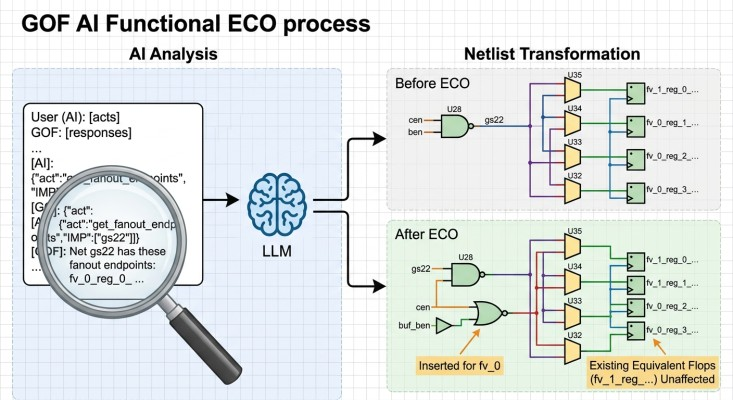
This approach ensures that the existing equivalent flops fv_1 remain unaffected by the ECO, preserving the functional integrity of the design.
GOF AI's ability to directly manipulate netlists using LLM intelligence marks a significant leap forward in functional ECO. It not only saves time but also reduces the risk of introducing unintended changes, leading to faster and more reliable design closures.